Prov 17:22

A merry heart doeth good like a medicine... - Proverbs 17:22
Showing posts with label parenting. Show all posts

Sunday, June 28, 2026

Sundays in the Psalms: Worst Mother Ever?


PSALM 17

Keep me as the apple of your eye; hide me in the shadow of your wings
from the wicked who are out to destroy me, from my mortal enemies who surround me.

—Psalm 17:8-9 NIV

One might think that the safest place for a baby marsupial is in its mother’s pouch. In truth, a mother quokka (one of the cutest and most photogenic animals because of its natural smile) is hardly winning any mother-of-the-year awards. When threatened, quokkas, kangaroos, and other marsupials will relax their pouch muscles, causing the baby to fall to the ground. In the ultimate survival strategy, the mother gets away while the baby flails around on the ground, making noise and distracting the predator. According to an article by environment reporter Nick Kilvert, she’s more interested in her own survival and future reproduction. I can’t think of a sadder or more pathetic image than that wee creature, crying out for protection but receiving none.

A mother bird, however, regardless of species, will rarely abandon her young. Instead, the hen shields her chicks under her wings from predators, from the elements, and from other dangers. The image is so powerful, it’s used multiple times in scripture—a beautiful image for us of God’s sheltering protection. The mother bird cherishes her little ones with the warmth of her own heart. We may not enjoy seeing ourselves as helpless and vulnerable as a baby bird. But in those moments of threat from any source, how precious to know we have a God who shelters us under his wings.


Question for reflection: David wanted to be kept by God as if he were something valuable and even fragile. He saw himself as God’s cherished child. Do I?


Sunday, March 15, 2026

Sundays in the Psalms: The Kids are Watching


PSALM 7

Whoever digs a hole and scoops it out
    falls into the pit they have made.
The trouble they cause recoils on them;
    their violence comes down on their own heads.

—Psalm 7:15-16 NIV

While visiting her parents for the holidays, Kim was driving around her hometown with her mother in the front seat and her two children in the back. Frustration grew as her mom played the side-seat driver, sucking in air between her teeth when she thought Kim was about to pull out in front of an oncoming vehicle. 

In reality, Kim had grown competent at driving in a big city, where a single hesitation often meant a long, unnecessary wait. Resentment began to simmer. When her mother asked her to make a quick stop at a friend’s house to drop something off, Kim pulled in front of the house on the left side of a two-way street.

“You can’t park like this.”

Her mother’s admonishment was the last straw.

“Mom. I don’t care!”

Her mother jumped out of the car to drop the item into her friend’s mailbox, declaring that she wouldn’t pay the fine if Kim got a ticket.

No ticket was forthcoming, but within twenty-four hours, both of Kim’s children—at separate times—repeated the words she’d thrown at her own mother, right down to the exact hand gestures: “Mom, I don’t care!”

Fortunately, Kim had the self-awareness required to see herself reflected in her children’s words. If they weren’t allowed to speak to their mother that way, why was she? Her mother received—and offered—an apology the following day, and lessons were learned by all.

Questions for Reflection: How quick am I to recognize when I’ve fallen into a pit of my own digging? How quick am I to be a "side-seat driver?"

Friday, April 19, 2024

Lessons from My New Babies

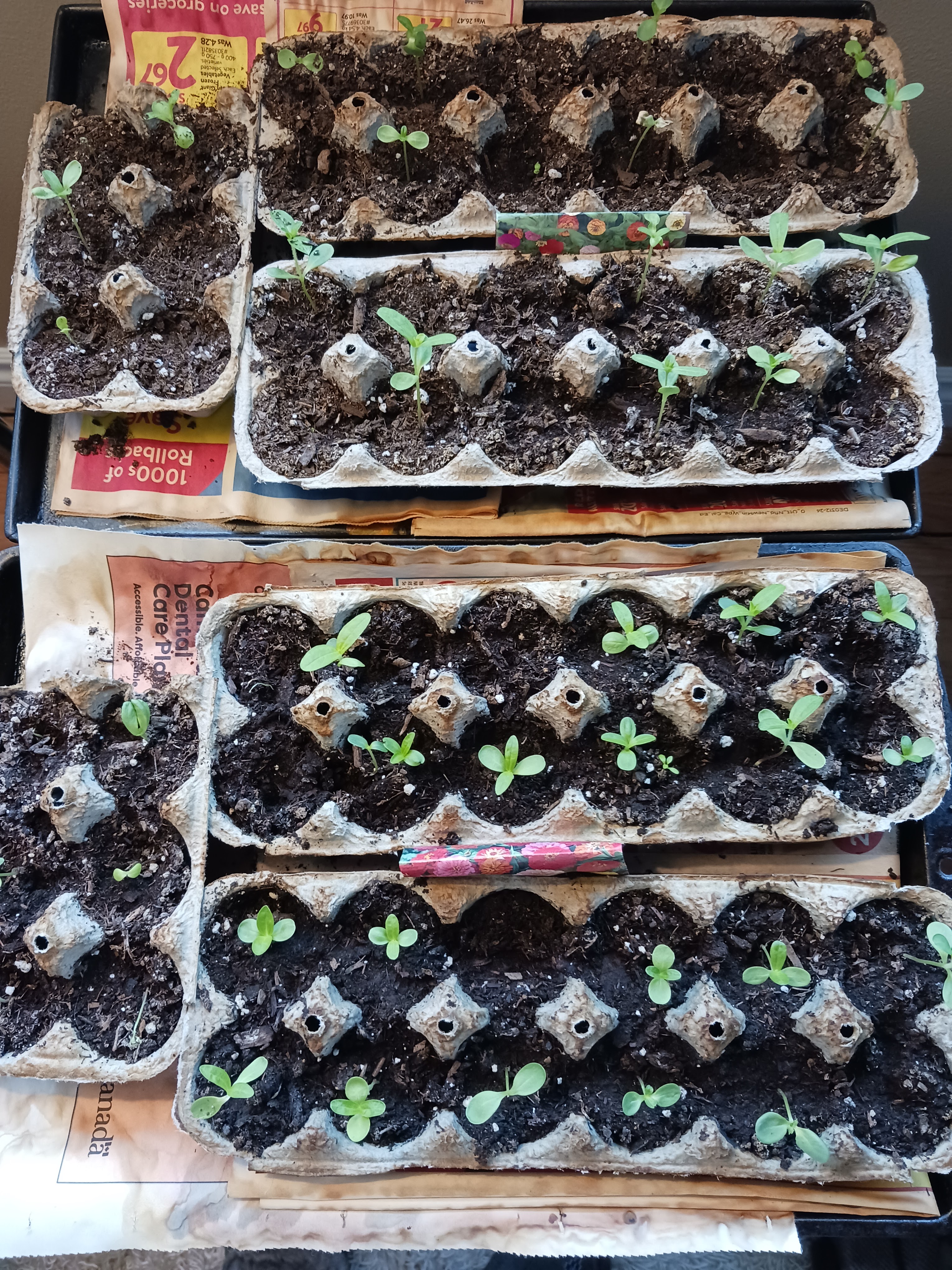
On the official first day of spring, I decided to start some seeds indoors for transplantation outdoors when the time comes. A new-to-me, money-saving venture. In two packages of zinnia seeds costing $1.50 each, I counted 60 seeds. Imagine getting 60 bedding plants for the price of one! I’d seen online where someone used cardboard egg cartons to start the seeds, one per cup, and then simply planted the whole tray so the paper could decompose and the seedlings would be evenly spaced. Seemed like a great plan.

I covered my kitchen table with newspaper and cut the lids off the five egg cartons I’d been saving. I stirred up some potting soil with water to make a nice mud, then spooned some into each egg cup, kind of like making drop cookies. After pressing the tops flat, I poked a one-quarter-inch hole in the center of each with a chopstick. Then, using tweezers, I dropped a seed into each hole and covered it with the soil.

I lined old cookie sheets with newspaper and placed the egg cartons on them, then lay them on a table in the living room where direct sunlight pours in for nine or more hours a day. I kept the soil damp. By Day Four, the first tiny sprouts appeared.

How many gazillions of times has this little ancient miracle played out on this earth? Yet still, it’s worthy of our awe. We can plant and water and fertilize, but we cannot give life. We cannot make a seed to save our lives. If God does not do his life-giving part, nothing happens. Partnership at its finest.

By Day Six, half the sprouts were up and the keeners among them reached for the sun. Now I’m watching, watering, and wondering. Will some fail to sprout? Will the plants become root-bound in those tiny egg cups before my garden’s warm enough to receive them? Will the paper disintegrate and everything fall apart? Already, I realize I’ll need to cut each cup apart or they’ll stand too close together to thrive in the garden.

Gosh, this gardening feels a lot like parenting.

Here’s the thing. If a seed fails, my first question is not, “What’s wrong with it?”

Instead, I wonder what it needs that it isn’t getting. I’m asking where I’ve failed.

Yet how often, when we see someone—perhaps ourselves—who isn’t growing like we think they ought, do we wonder what’s wrong with them instead of asking what they need? Seeds are made to grow. Given the right environment—soil, water, sun—they will. You and I were made to grow, too—physically, emotionally, spiritually, and mentally. We’re made to thrive, to become stronger the more we grow, the more challenges we overcome. When that doesn’t happen, it doesn’t mean something’s wrong with us. It means we need something we haven’t received.

Asking the right question can lead to better answers and help us to be kind to ourselves and others. My baby plants depend on me—without asking, begging, demanding, or worrying. They simply receive what I offer and do what they were made to do.

We thrive best when we allow the One who created us in the first place to be our source of light, our wellspring of nourishment, our foundation of love, our cradle of understanding, and our font of wisdom. When we stop striving and struggling. When we simply bask in his provisions and then do what He made us to do.


Thursday, September 15, 2022

The Mouse House

In the fall of 1986, I was the mother of two pre-schoolers with another on the way. Christmas was coming. Money was tight. What I did have was a new Pfaff sewing machine. My father had died earlier that year and we’d received a bequeathment. I knew I wanted to use part of the money to buy a good sewing machine. I’ve never regretted that decision, and I think of Dad every time I use it.

I also owned a trunk of assorted fabrics, old clothes, and crafting materials. When I found a pattern for a little fabric doll house and its three family members—which you could make either as bunnies or mice, I decided to make our three-year-old daughter a mouse house.

This, of course, required working only while the children slept.

The first step was cutting out ALL. THE. PIECES. The walls and roof were reinforced with plastic, then padded with batting before adding fabric on both sides That’s a lot of pieces. The roof and carrying handle were made from leftover fabric I’d used to make my husband a shirt, the walls from a discarded dress. Half the roof lifted up while the front wall could be raised or lowered using zippers along each corner. Each wall included at least one window, complete with shutters and flowery window boxes on the outside, curtains on the inside. The little red door opened and closed with a snap. I even found an old pair of child’s pajamas printed with cute little mice to cut out “family portraits” to hang on the inside of the walls.

Furnishings included a little bed with a quilt and pillow. I made the sofa and matching armchair from a dress I’d worn in Grade Seven.

The three mice were made from fuzzy blue fabric with pink lining for their ears and tails of braided blue yarn. Mama Mouse wore her own little bib apron, while Papa and Baby sported only red ribbons around their necks. 

Those walls stood much straighter in 1986.

As Christmas grew closer and my belly grew bigger (our third arrived January 7), I feared I’d never finish the mouse house on time. Then hubby had to attend a conference that involved staying in a downtown Winnipeg hotel. Did I want to go along? Boy, did I!

We farmed out the kids. I packed my sewing machine and all the cut-out parts, then set up shop in our hotel room. Two uninterrupted days to work on this project felt like the biggest treat. There I sat, larger than a house myself, working away at a sewing machine. Thread, stuffing, and Velcro bits lay scattered about. I can only imagine the “guess what I saw today” story the housekeeper told after leaving our room.

Our girl spent many happy hours playing with her mouse house. Last Christmas, she discovered it in our storage room and decided to take it home. I said, “At least let me fix it for you.” The roof was falling off, the furniture coming apart, the mice looking extremely ratty.

She didn’t argue. I put the house in my office so I wouldn’t forget about it.

Seven months went by.

Finally, realizing I would see Mindy again at the end of September, I got to work. This time I used a glue gun for several of the repairs, saving myself a ton of stitching. The mouse family received new whiskers. I reinforced their tails. Mama Mouse underwent eye surgery which altered her appearance, but her vision remains unchanged.

I probably spent a good six hours fixing the mouse house. Although none of those hours were interrupted by children, I do find threading a needle more time-consuming than I did 36 years ago. Go figure.

Jesus of Nazareth, the most talented carpenter who ever lived, is preparing a place with “many houses” for his beloved children. I like to think he’s putting all the care and love into mine that I put into Mindy’s mouse house—but with a lot more skill, and no need for repairs in 36 or 360 or 36,000 years.

I can’t wait to open the door to mine!


Friday, February 7, 2020

"Something Else" is Not on the Menu


I made an uneducated observation last month while caring for two grandsons for 182 consecutive hours. Not that I was counting or anything.

I’m grateful to have had the opportunity of getting to know these little guys well and for them to know and remember me. I will always treasure the two-year-old’s “Tankoo, Damma” for every little thing I did for him, and the four-year-old’s detailed and often bewildering explanations for life’s mysteries. I’m glad I could give my daughter and son-in-law this needed break.

But I also returned home with renewed understanding of why God gives children to young people—it takes an astonishing amount of energy! I don’t know how many times I found myself shaking my head, thinking “I don’t remember it being this hard!”

Honestly? I’m not sure it was. And not simply because I was younger.

Parents today are doing a lot of things far better than we did. I love seeing how my kids play with their kids and invest effort into creating warm, meaningful memories for them. I appreciate the safer car seats, healthier food, and appropriate disciplinary methods.

Still, experts keep telling us that today’s children (and their parents) suffer from stress-induced depression and mental illness in more alarming numbers than ever. I can’t help wondering if one contributing factor might be the myriad of choices set before them in a day. From their clothing, toys, books, food, activities—kids have dozens and even hundreds of options from which to choose.

Take television. When my children were little, we never had cable and the internet was still in the future. Weekday programming for preschoolers consisted of Mr. Dressup, Fred Penner, and Sesame Street. The only options were to watch or not watch. If you missed it, you missed it. As a young mom, I relied on those two hours each morning for my own sanity and to accomplish some uninterrupted work. No one told me it was too much TV.

Now, select “Kids” on Netflix any hour of the day and you can scroll through seemingly endless selections of shows designed to educate and entertain your children. That doesn’t include You Tube, regular TV, the Disney channel, Christian programming, or any other subscription services available. At the same time, parents feel overwhelmed with guilt as they’re warned of all the dangers to little brains and emotions that come with too much screen time.

My grandsons have more clothes in their dressers, more food in the fridge, more snacks in the pantry, more toys and books than their parents ever had. This isn’t a bad thing and I know it’s good for kids to practice choosing. I’m just not convinced a child of two or four is emotionally equipped to make so many decisions every hour of the day. Sometimes it’s more than enough for them to figure out whether they are hungry or cold or in need of a bathroom.

So when this grandmother declared that “something else” wasn’t on the menu, or when she picked out the pajamas in the interest of time, or when she narrowed down the storybook selection to only two, she felt like a big meanie. But for the most part, it worked. I suspect nobody suffered any long-term ill effects. And, in my unprofessional opinion, the result just may have been a little more peace, security, and well-being for all.

Sunday, September 1, 2019

More Lessons from my Garden


With all the wonderful weather we’ve been experiencing this summer, my garden has been gloriously prolific. Likewise, the lessons it is teaching me are too rich to be contained in one blog post. Here’s the continuation of a previous week’s lessons.

Tomato Cages and Parenting
I planted three different tomato plants this year, one much taller than the others. I should have placed cages around them as soon as I removed them from their little containers and laid them in the ground. A month or more went by before I finally purchased cages. By then, the tallest one resisted the cage like a moody teenager resists curfew. In my attempt to force one of its branches through the cage, I broke it off completely, losing a couple of marble-sized tomatoes.

When the next windstorm came along, it blew that tall plant over, cage and all. (Hubby says I should have stapled the cage into the ground with long wires. Now he tells me.) Too late to force the crooked, wonky cage back into the ground, I was left with no choice but to set the plant free from it. Except by now, some of the thicker branches were entangled with the cage. It wouldn’t budge. Finally, I just held my breath and yanked the cage straight up, surrendering whatever branches might break off. This time, I lost several golf ball-sized tomatoes.

Oh, the plant is still alive. It’s still producing. But it has not been and never will be as healthy or productive as the plants given their cage while still small.

Little children want boundaries. They feel safe knowing what the rules are and knowing someone will enforce them. When healthy boundaries are set in place early on, humans can thrive and grow and become all they were meant to be.

If you wait too long and try to play catch-up later? You will be met with resistance. It will prove far more difficult, and you’ll do a lot more damage. It doesn’t mean the person can’t still be strong and productive, but unnecessary pain will be inevitable along the way.

A Little Each Day…
If you’ve ever gone away on vacation during a garden’s prolific period, you know the pain of returning home to overgrown weeds, overripe vegetables, and dehydrated plants. It can take you days to return things to order. Plus, you’re wasting what would have been perfectly good produce if you’d been home to pick it. Sometimes there’s no reviving a plant dead from thirst, starving for nutrients, or choked out by weeds.
 
This is why good gardeners do a little each day. From the day they till the soil until they’ve pulled out the last dead plant in preparation for winter, the devoted gardener is out there. Weeding, watering, thinning, fertilizing, harvesting, and cleaning out what’s finished are far easier when done daily, bit by bit. You’ll enjoy a much healthier, productive garden.

This is true for your soul as well. A little time devoted to scripture and prayer every day produces more fruit than church once a week or a spiritual retreat once a year. Don’t choke out your soul with neglect. The weeds will gladly take over while you’re not paying attention.

Greener Where you Water…
We’ve all heard it said that if the other man’s grass is always greener, it’s probably because he waters it. This becomes even more obvious after a dry spell when your lawn turns brown while the neighbor with the sprinkler system is still enjoying lush green turf.

The application to our lives and relationships hardly needs mentioning. Marriages, friendships, and family relationships dry up with neglect. Watering takes effort. Make the effort. ‘Nuff said.